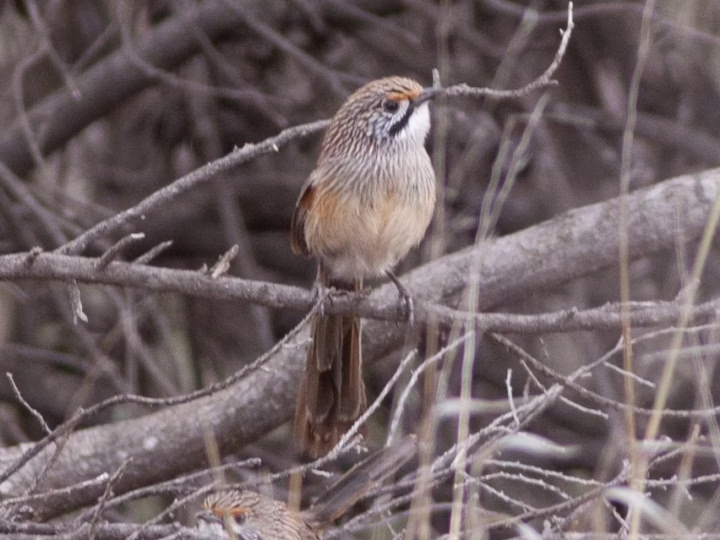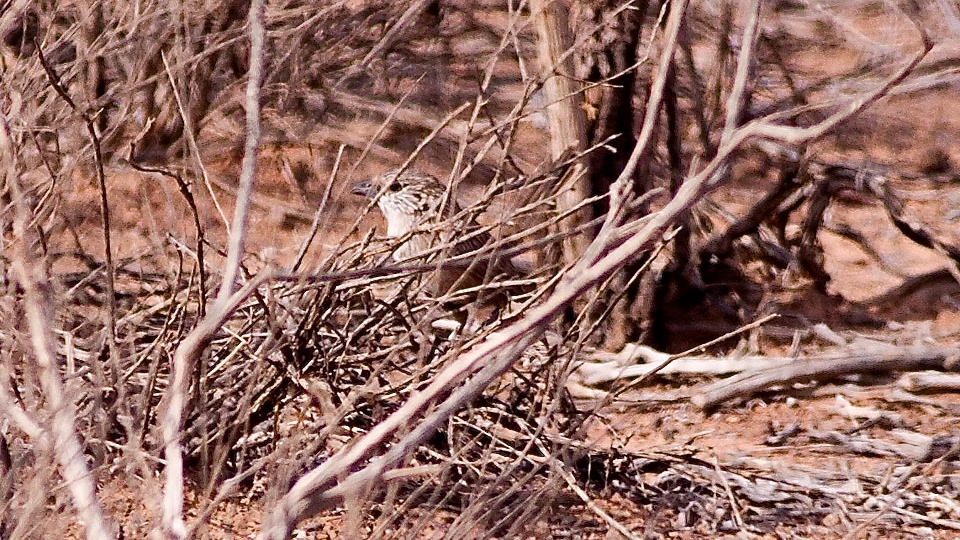
The Thick-billed Grasswren (Amytornis modestus) is an Australian bird best identified by combining its shape, plumage, habitat, range and behaviour rather than relying on a single colour. A sturdy grasswren with a thick bill, long graduated tail, warm brown plumage and strong pale streaking. Adults are typically about 17–20 cm long. Light, distance, moult, age and sex can all change how a bird looks, so a confident field identification is strongest when several clues agree.
How to identify a Thick-billed Grasswren
A sturdy grasswren with a thick bill, long graduated tail, warm brown plumage and strong pale streaking. Start with overall size and proportions, then check the bill, head pattern, upperparts, underparts, wings, tail and legs. Notice where the bird carries its body and tail: some species sit upright on exposed perches, while others stay horizontal in foliage or move almost entirely on the ground. These structural clues often remain useful when colours are hard to judge.
Runs rapidly between shrubs and usually stays close to cover, perching briefly on low bushes when calling. Voice is also valuable. Listen for the rhythm, pitch and repetition of calls rather than trying to memorise a written sound. If possible, watch the same bird for several minutes and note how it feeds, where it perches and whether it moves alone, in a pair or in a flock. A short sequence of behaviour usually gives more information than a single photograph.
Where does the Thick-billed Grasswren live in Australia?
Patchily distributed through arid inland Australia, including parts of South Australia, the Northern Territory and western New South Wales.
Range is an important reality check when identifying Australian birds. A bird that looks superficially right may be unlikely if it is well outside the normal distribution, although seasonal movement, drought, fire and exceptional weather can occasionally shift birds beyond expected areas. Local checklists and recent records can help when the observation is near the edge of the known range.
Habitat
Typical habitat includes Saltbush, bluebush, chenopod shrubland and low arid scrub, often on stony or clay plains. Habitat should be treated as part of the identification, not just background scenery. Record whether the bird is in dense understorey, open canopy, grass, rocks, mangroves, wet forest or arid scrub, and note the height at which it spends most of its time. Closely related species often separate more cleanly by habitat and foraging level than by plumage alone.
What does the Thick-billed Grasswren eat?
The Thick-billed Grasswren feeds on Seeds, insects and other small invertebrates. Feeding style can be a strong clue in the field. Watch whether it gleans prey from leaves, pounces onto the ground, probes bark or crevices, catches insects in the air, picks seeds from the soil or searches inside dense vegetation. Where a bird feeds and how it handles food can help distinguish it from similar species.
Behaviour and calls
Runs rapidly between shrubs and usually stays close to cover, perching briefly on low bushes when calling. Many Australian birds change their behaviour with weather, breeding condition and food supply, so one observation will not show the full range of habits. Early morning is often the easiest time to hear calls and observe feeding. Avoid playback around active nests or repeatedly pushing into dense cover simply to obtain a closer photograph.
Nesting and breeding
Builds a domed nest low in dense shrubs or grass tussocks. Breeding timing varies across Australia and may shift with latitude, rainfall and food availability. If you find an active nest, eggs or dependent young, observe from a respectful distance and avoid repeatedly approaching the site. Nest placement and construction are useful identification clues, but the welfare of the birds comes first.
Similar birds
The safest way to separate the Thick-billed Grasswren from similar birds is to combine its approximate size of 17–20 cm, the appearance described above, its Australian range and its usual habitat. Compare bill depth, face pattern, tail length, wing markings and feeding style. For difficult birds, photographs from more than one angle, a short audio recording and notes about behaviour can be more useful than trying to force an identification from one view.
Quick identification tip
Remember three things: A sturdy grasswren with a thick bill, long graduated tail, warm brown plumage and strong pale streaking. a typical size of 17–20 cm; and a strong association with Saltbush, bluebush, chenopod shrubland and low arid scrub, often on stony or clay plains. If those clues agree with the range and behaviour, Thick-billed Grasswren becomes a strong candidate. For unusual records, check a current Australian field guide or local bird records before treating the identification as certain.
Sources and further reading
Species information should be checked alongside current Australian references such as BirdLife Australia bird profiles and the Australian Museum bird collection. Taxonomy, conservation status and known distribution can change as new research and observations are published.