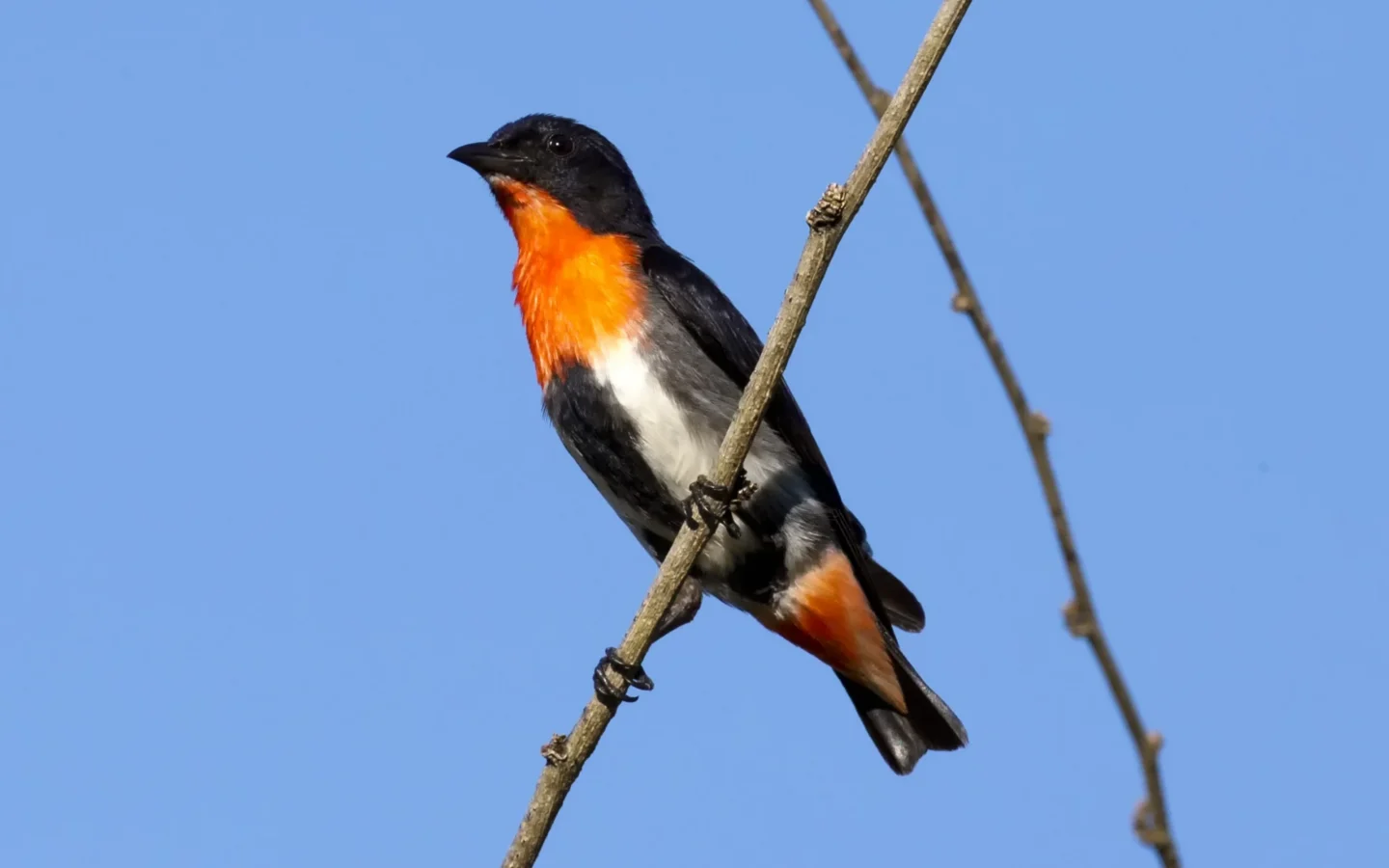
Trying to identify an Australian bird? Start with the features you noticed first: colour, size, shape, beak, habitat and behaviour. BirdGuide is designed to help you narrow a sighting quickly, then compare likely species using detailed Australian bird profiles.
Start with the bird’s strongest clue
You do not need to know bird families or scientific names. Think back to the sighting and ask a few simple questions. Was the bird mostly black and white? Did it have a bright red head, a yellow crest, a long curved beak or vivid green plumage? Was it tiny and moving through shrubs, or large and standing beside water?
Colour is useful, but it is rarely enough on its own. Light can make dark feathers look blue, green or grey, and juvenile birds may look quite different from adults. The most reliable identification usually comes from combining several clues.
Australian bird identification guides
- Black and white birds in Australia — compare magpies, magpie-larks, butcherbirds, cormorants and other pied species.
- Small blue birds in Australia — start with fairywrens and other small birds that can appear blue in the field.
- Birds with red heads in Australia — compare rosellas, King-Parrots and other red or pink-headed birds.
- Bright green birds in Australia — useful for lorikeets, parrots, bee-eaters and green-toned birds.
- Yellow birds in Australia — identify birds with yellow crests, wing flashes, breasts or other strong yellow markings.
- Australian birds with long beaks — compare ibises, herons, pelicans, oystercatchers and other long-billed species.
- Australian parrots identification guide — compare common lorikeets, cockatoos, corellas, rosellas and King-Parrots.
- Australian water birds identification guide — compare ducks, swans, moorhens, pelicans, herons, cormorants and shorebirds.
Five clues that make bird identification easier
1. Size
Compare the bird with something familiar. Was it sparrow-sized, pigeon-sized, magpie-sized or much larger? Even a rough estimate can remove many unlikely candidates.
2. Shape
Notice the body shape, tail length, wing shape and posture. A hovering falcon, upright heron, compact parrot and ground-walking magpie have very different silhouettes.
3. Bill
Bill shape often reveals how a bird feeds. Parrots have strong curved bills, ibises have long down-curved bills, herons have straight spear-like bills and finches have short seed-cracking bills.
4. Location and habitat
Record where you saw it. A bird in a suburban Brisbane garden has a different shortlist from a bird on a coastal mudflat, inland grassland or alpine forest. Habitat is often as useful as colour.
5. Behaviour and sound
Did it hover, fan its tail, dive, walk on the ground, feed from flowers or sit motionless on a branch? Calls can be even more distinctive than plumage. If you can safely record a short audio clip or photograph, it may help you confirm the identification later.
Not sure yet?
Browse the Australian bird directory and compare several candidates rather than forcing a match from a single feature. When two birds look similar, pay close attention to bill shape, eye colour, legs, tail pattern, voice and the exact part of Australia where the bird was seen.
BirdGuide will continue expanding these visual identification guides as more Australian species are added to the library.