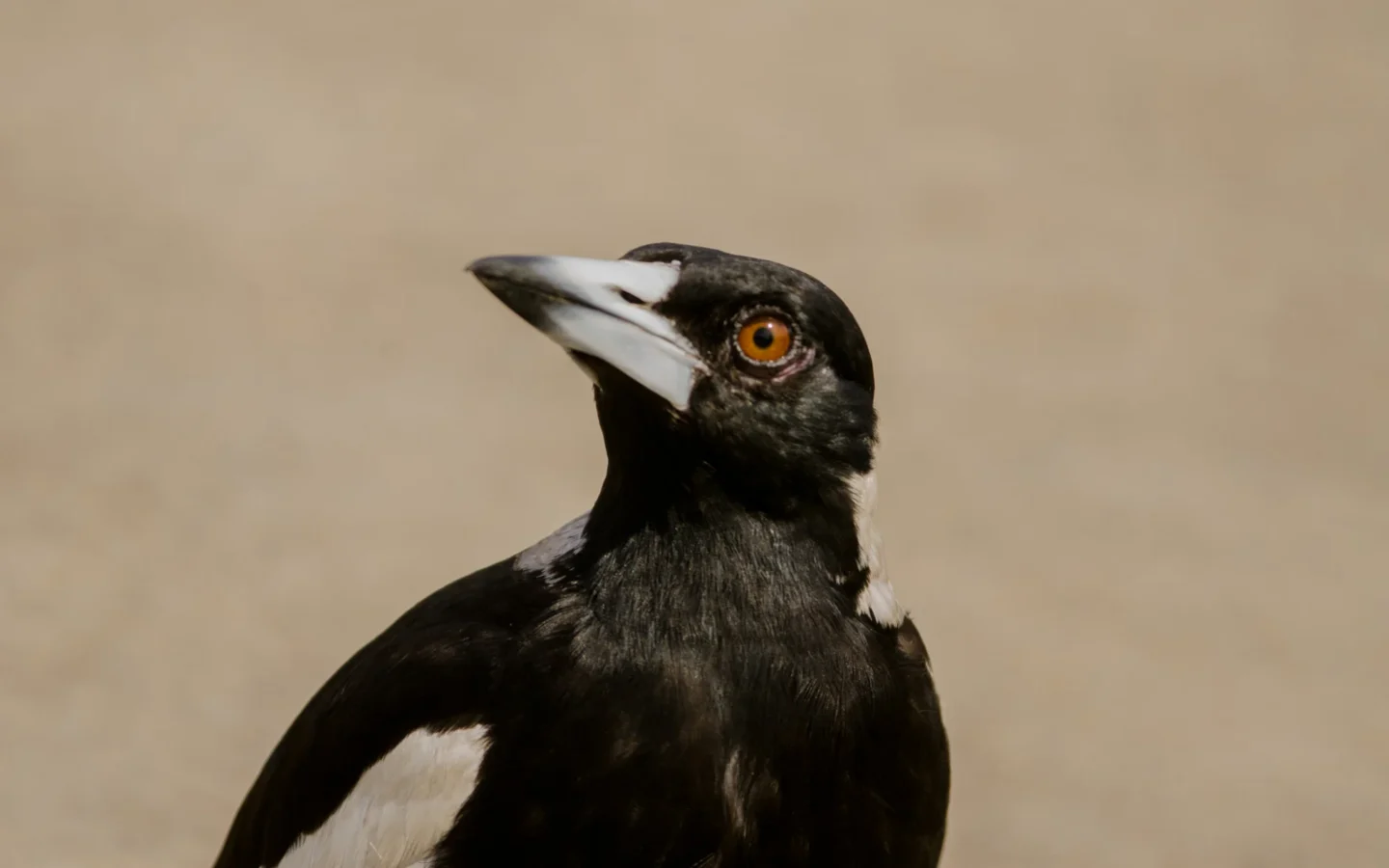
The Australian Magpie (Gymnorhina tibicen) is a large black-and-white songbird found across most of Australia. It has a heavy body, long legs, a strong wedge-shaped pale bill and chestnut-brown eyes as an adult. The exact pattern of black and white varies geographically, so identification is easier when you consider shape, voice and behaviour as well as plumage.
How to identify an Australian Magpie
Australian Magpies are about 36–44 cm long. Most adults are predominantly black with contrasting white on the nape, shoulders and rump or back, depending on region and sex. Adult males usually show cleaner white areas, while females can have greyer or mottled sections on the back or nape.
The bird’s sturdy proportions are useful clues. It is more heavyset than a Magpie-lark and has a much stronger bill. Its rich carolling and flute-like warbling are also among the most recognisable bird sounds in Australian parks and suburbs.
Where do Australian Magpies live?
Australian Magpies are widespread across mainland Australia and Tasmania wherever there is a useful mixture of open ground for feeding and trees for roosting and nesting. Common habitats include open woodland, farmland, playing fields, golf courses, parks and suburban streets.
They are less likely in the densest closed forests or the most arid desert areas. A local family group can occupy and defend the same territory throughout the year, which is why the same magpies may become familiar visitors around a home or park.
What do Australian Magpies eat?
Magpies spend a great deal of time walking across lawns and open ground searching for food. Insects and their larvae are important prey, and the birds use their bill to probe or pick items from the soil and grass.
Their broader diet can include other invertebrates, small frogs or lizards, seeds, fruit, carrion and human food scraps. Regularly feeding magpies is not necessary. Maintaining healthy lawn, garden and habitat areas gives them opportunities to forage naturally.
Australian Magpie calls
The species is famous for complex, musical vocalisations. Individuals may produce soft warbling when alone, while pairs and groups perform louder carolling calls that help advertise and defend a territory. Magpies are also capable mimics and can reproduce sounds made by other birds and animals.
Why do some Australian Magpies swoop?
Only some individual magpies swoop people, usually during the breeding season when they are defending a nearby nest or young. The behaviour is temporary and localised rather than something every magpie does.
If a bird is defending a nesting area, giving it space and following local safety advice is preferable to approaching or disturbing the nest. Outside the breeding period, Australian Magpies are often relatively calm around people in places where they are accustomed to human activity.
Australian Magpie vs Magpie-lark
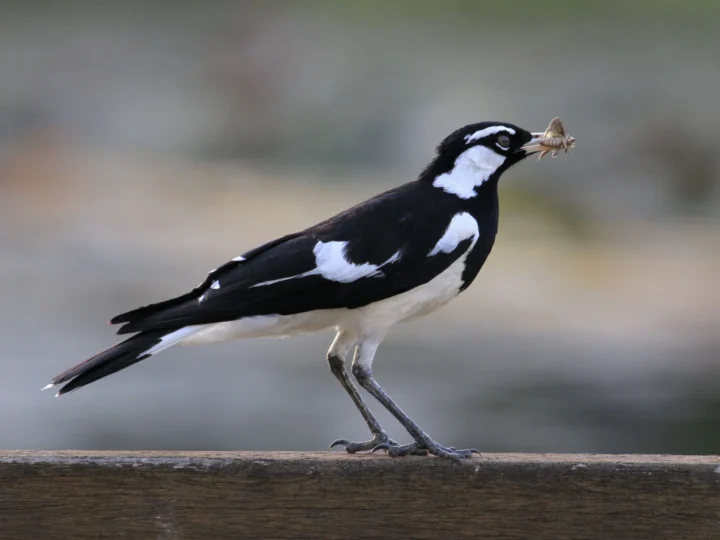
A Magpie-lark is noticeably smaller and slimmer, with a fine bill and sharply patterned black-and-white face. It often walks quickly across lawns and may be seen in pairs. The Australian Magpie is larger, bulkier and has a much heavier wedge-shaped bill.
Australian Magpie vs Pied Currawong
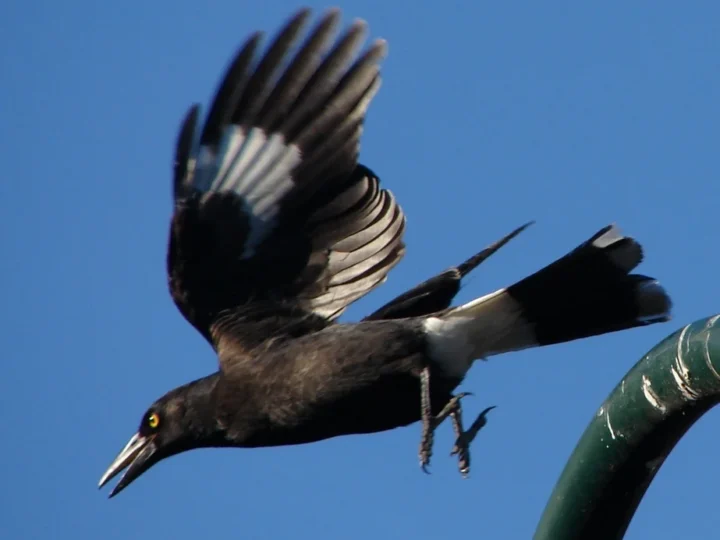
A Pied Currawong is mostly black with a bright yellow eye and white patches in the wing and under the tail. It lacks the magpie’s broad white nape or back pattern and sounds very different. Currawongs also tend to have a longer-looking bill and tail.
Quick identification tip
If you see a robust black-and-white bird around 40 cm long walking over open grass, with a strong pale bill and rich flute-like warbling, an Australian Magpie is the most likely identification.
Sources
Species information checked against BirdLife Australia and the Australian Museum.
.jpg)