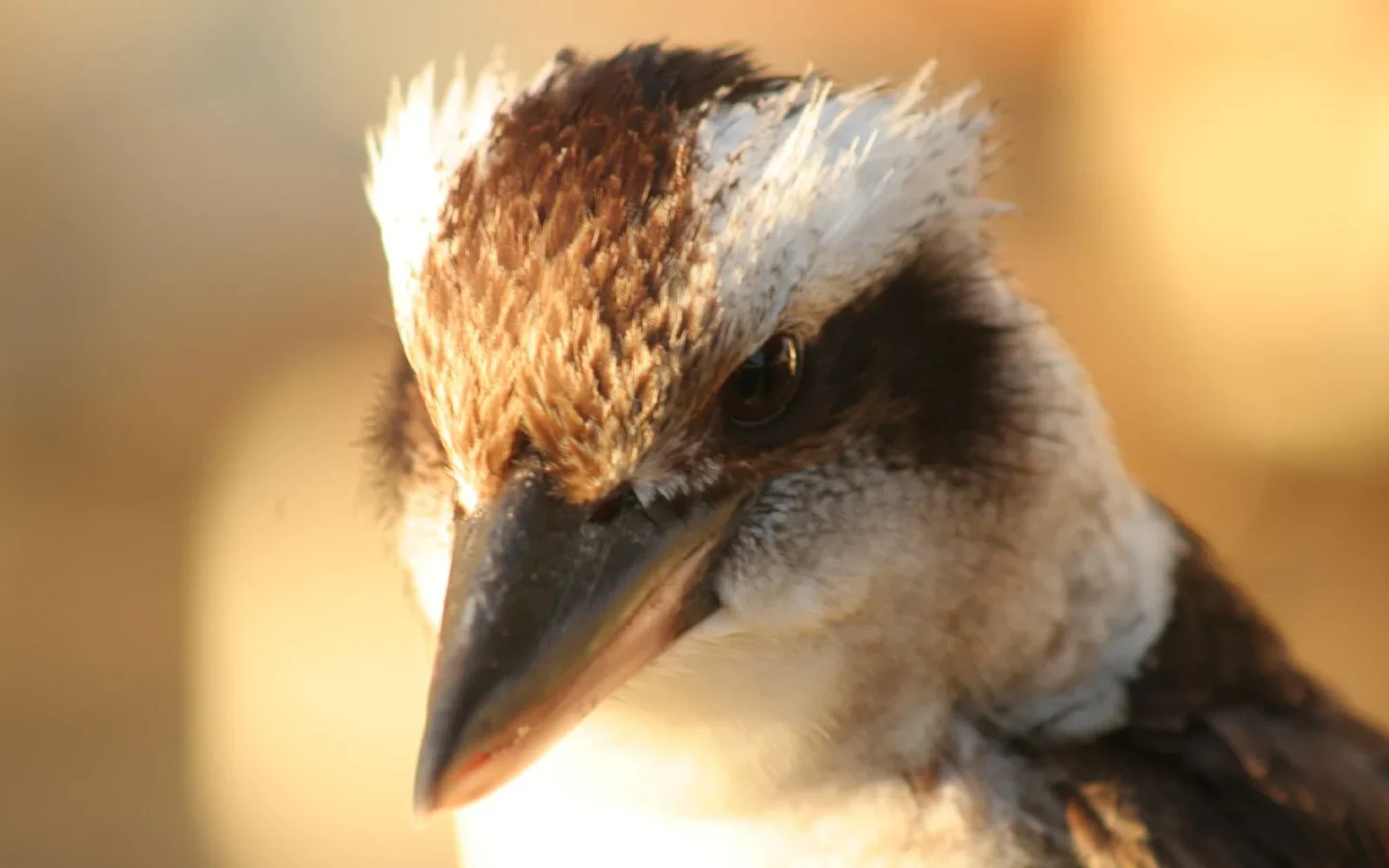
The Laughing Kookaburra (Dacelo novaeguineae) is Australia’s most familiar kingfisher. It is a large, sturdy bird with an oversized dark bill, off-white underparts, brown wings and back, a dark stripe through the eye and a rufous-brown tail barred with darker markings. Its famous “laugh” is actually a territorial call.
How to identify a Laughing Kookaburra
Laughing Kookaburras are about 40–45 cm long, making them much larger and heavier than the small kingfishers many people imagine when they hear the family name. Look for a broad head, powerful bill, brown-and-white body and a conspicuous dark eye-stripe.
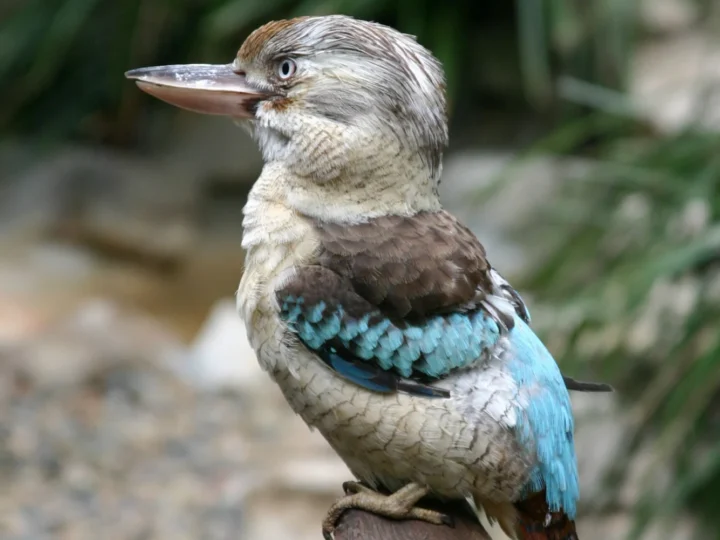
The wings can show patches of pale blue, but the bird is much less blue overall than the Blue-winged Kookaburra. When perched, Laughing Kookaburras often sit upright on a branch, fence or powerline while watching the ground for prey.
Why do kookaburras laugh?
The classic laughing chorus is not a sign that the bird finds something funny. It is primarily a territorial signal. Family groups may call together, especially around dawn and dusk, creating the rolling chorus that has become one of the best-known sounds of the Australian bush.
They also make shorter calls when communicating within the family group. Because voice is so distinctive, hearing a Laughing Kookaburra can be enough to identify it even when the bird is hidden in foliage.
Where do Laughing Kookaburras live?
The species is native across much of eastern Australia, from Cape York south through Queensland, New South Wales and Victoria. It uses forests and woodlands but also adapts readily to parks, farms and suburbs where mature trees provide perches and nesting hollows.
Laughing Kookaburras have also been introduced outside parts of their natural range, including Tasmania and south-western Western Australia. In those areas they can compete with native hollow-nesting wildlife and prey on local animals.
What do Laughing Kookaburras eat?
Despite being kingfishers, Laughing Kookaburras do not depend on fish. They commonly eat insects, worms and crustaceans, and may also take frogs, reptiles, small mammals and occasionally small birds.
A typical hunting method is to wait on a perch and then drop or pounce onto prey. Small food items may be swallowed quickly, while larger prey can be struck against the ground or a branch before being eaten.
Nesting and family behaviour
Laughing Kookaburras commonly nest in natural tree hollows or sometimes in cavities in arboreal termite mounds. They live in strongly social family groups. Older offspring may remain with their parents and help defend the territory, incubate eggs and feed younger birds.
That family structure helps explain why several kookaburras are often heard calling together. The group is advertising ownership of a territory rather than simply making random noise.
Laughing Kookaburra vs Blue-winged Kookaburra
The Blue-winged Kookaburra is the main look-alike, especially in northern Australia where the species can overlap. Blue-winged Kookaburras generally show much stronger blue colouring on the wings and rump and lack the Laughing Kookaburra’s strongly barred rufous tail. Location is also useful: Blue-winged Kookaburras are more characteristic of northern Australia.
Quick identification tip
A large brown-and-white kingfisher with a heavy dark bill, dark eye-stripe and unmistakable laughing territorial call is very likely a Laughing Kookaburra.
Sources
Species information checked against BirdLife Australia and the Australian Museum.