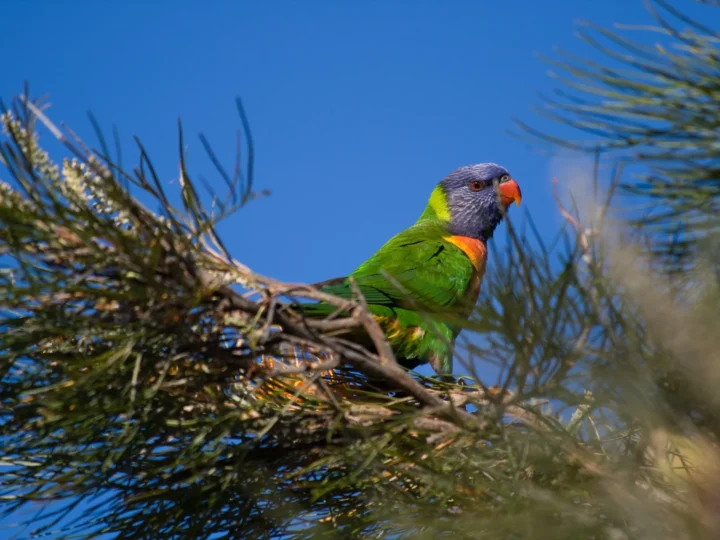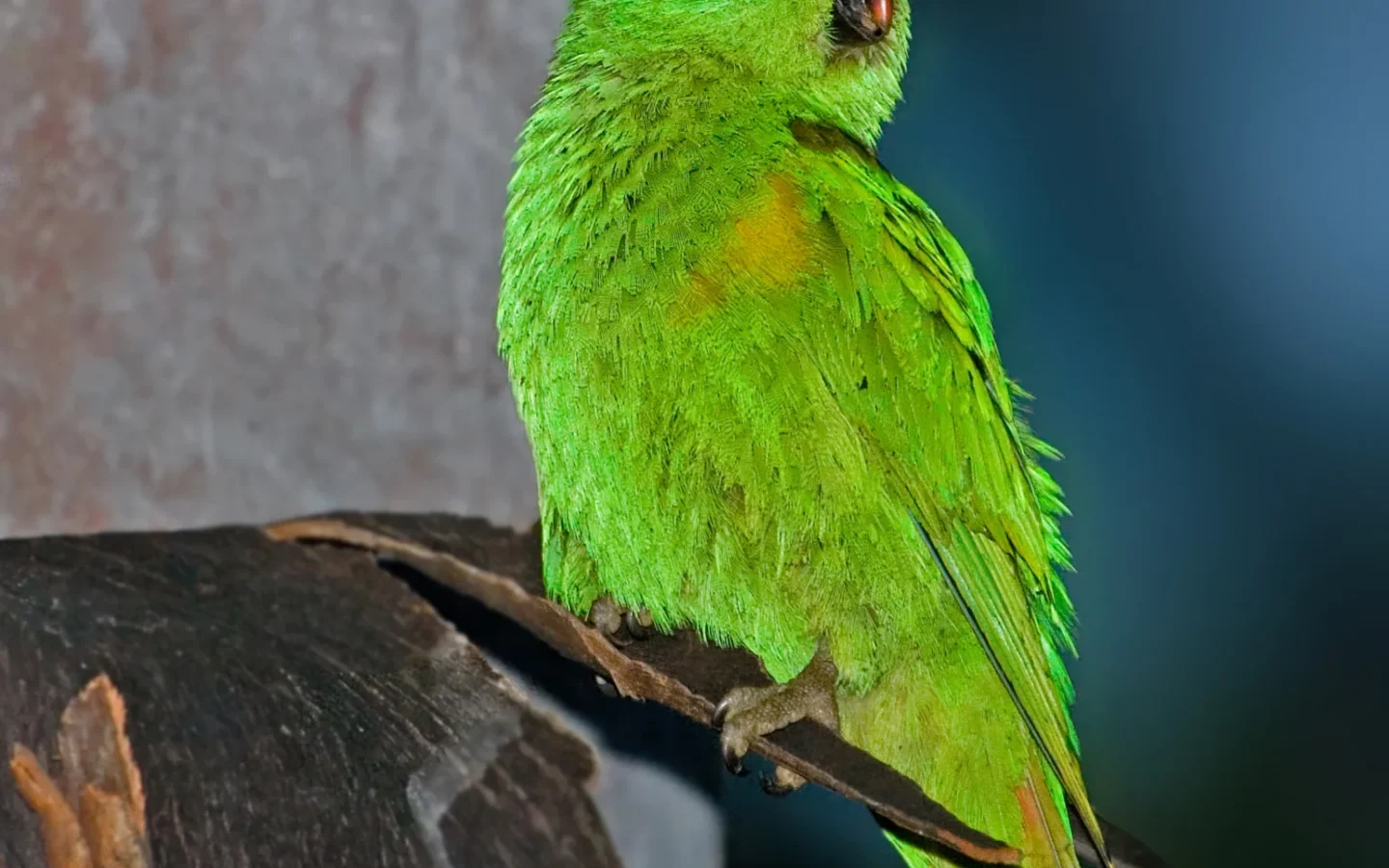
The Musk Lorikeet (Glossopsitta concinna) is an Australian bird worth learning as a combination of shape, colour, voice, behaviour and location rather than from a single feature. A small mostly green lorikeet with a red forehead and red through the face, a blue crown patch and a compact, pointed-tailed shape. Adults are typically about 20–23 cm, so comparing the bird with familiar nearby species can immediately narrow the identification.
How to identify a Musk Lorikeet
A small mostly green lorikeet with a red forehead and red through the face, a blue crown patch and a compact, pointed-tailed shape. Start with overall body shape and size, then check the head, bill, wings, tail and any strong colour blocks. If the bird is distant, behaviour and habitat may be more reliable than small plumage details.
Highly mobile and often nomadic in response to flowering. Flocks can feed high in the canopy and are sometimes easier to locate by their calls than by sight. Take a few seconds to watch how the bird moves before trying to name it. Whether it dives, hovers, fans its tail, climbs through foliage or feeds on the ground can eliminate many look-alikes.
Where is the Musk Lorikeet found in Australia?
South-eastern mainland Australia, including parts of South Australia, Victoria, New South Wales and southern Queensland.
Typical habitat includes flowering eucalypt forest, woodland, parks, street trees and gardens where nectar is abundant. A useful identification check is to ask whether the habitat makes sense for the species. Australian birds can wander, but a bird seen in its normal habitat and range is a much stronger match than one identified from colour alone.
What does the Musk Lorikeet eat?
Mostly nectar and pollen, together with flowers, fruit and some seeds or insects. Diet can change with season, rainfall and local food supply, so feeding behaviour is usually more useful as a supporting clue than as a stand-alone identification feature.
When observing wild birds, natural foraging is the best guide. Note whether the bird feeds in flowers, probes the ground, pursues prey in flight, dives underwater or cracks seeds. These behaviours also help explain why the species is associated with particular habitats.
Behaviour and calls
Highly mobile and often nomadic in response to flowering. Flocks can feed high in the canopy and are sometimes easier to locate by their calls than by sight.
Sharp, busy screeches and chattering contact calls from feeding or flying flocks. Calls are particularly useful when foliage, distance or poor light makes colour difficult to judge. Record a short description of the sound and the rhythm rather than relying only on a remembered word such as “chirp” or “screech”.
Nesting and breeding
Pairs nest in tree hollows, often in eucalypts. Breeding timing varies across Australia and may shift with latitude, rainfall and food. If you find an active nest or dependent young, watch from a respectful distance so adults can continue normal feeding and defence behaviour.
Similar birds
Rainbow Lorikeets are larger and much more multicoloured. Scaly-breasted Lorikeets are green and yellow without the Musk Lorikeet's red facial pattern. When two species seem possible, compare several independent clues: bill shape, body proportions, eye or face pattern, tail shape, voice, habitat and geographic range. A photograph from more than one angle is often more useful than one perfect-looking colour match.
Quick identification checklist
For a fast field check, remember four points: size: about 20–23 cm; appearance: A small mostly green lorikeet with a red forehead and red through the face, a blue crown patch and a compact, pointed-tailed shape.; habitat: Flowering eucalypt forest, woodland, parks, street trees and gardens where nectar is abundant.; and behaviour: Highly mobile and often nomadic in response to flowering. Flocks can feed high in the canopy and are sometimes easier to locate by their calls than by sight. If all four fit, the identification is much more convincing.
Sources and further reading
BirdGuide species information should be checked against authoritative Australian references as the site is expanded. Useful starting points include BirdLife Australia bird profiles and the Australian Museum bird collection. Image licensing for this page is recorded separately from the species information.