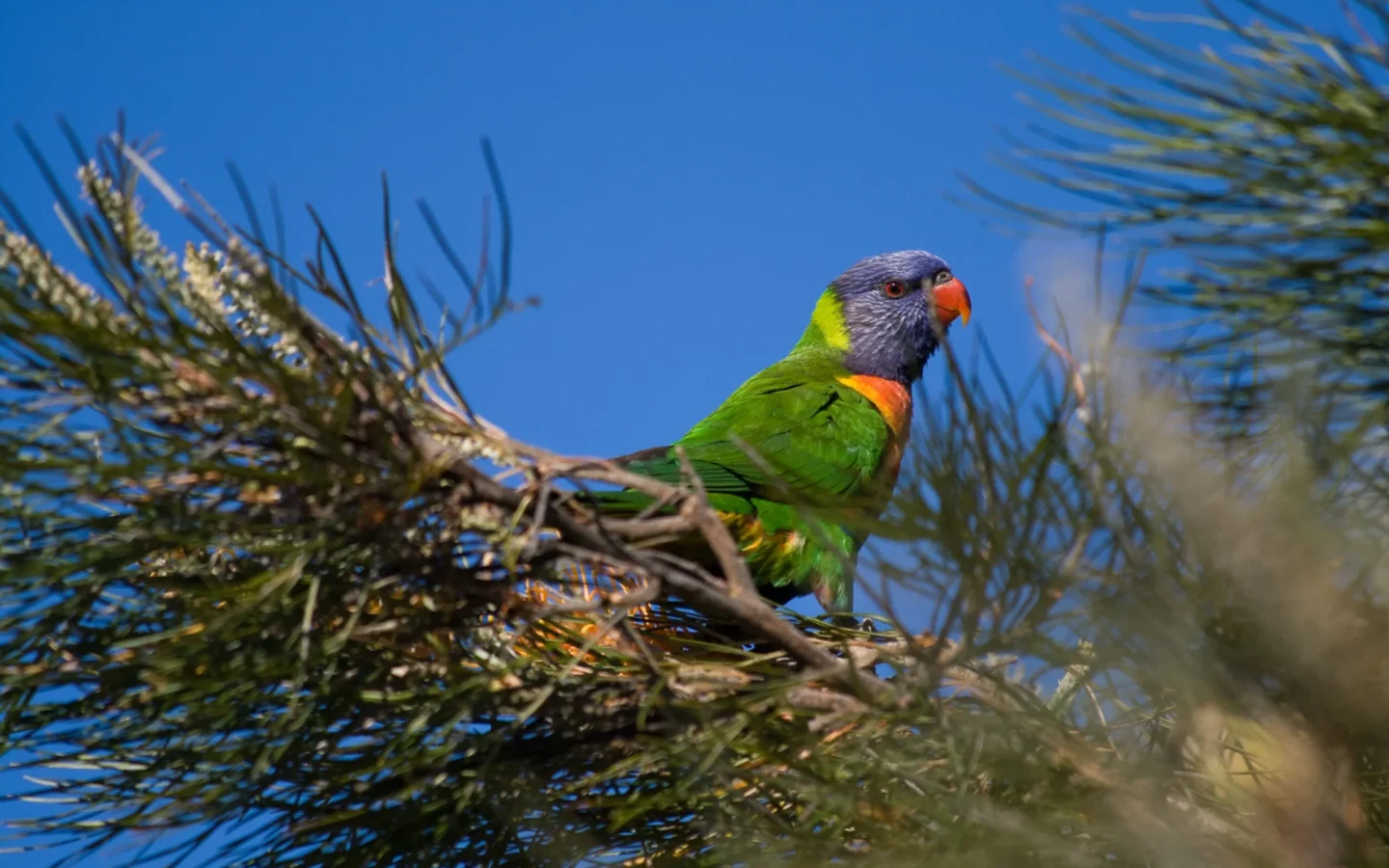
The Rainbow Lorikeet (Trichoglossus moluccanus) is one of Australia’s easiest birds to recognise. Look for a vivid blue to mauve head, bright orange-yellow breast, green wings and back, blue belly and a red-orange bill. Males and females look very similar, so colour alone will not reliably tell you the sex.
How to identify a Rainbow Lorikeet
At about 28–32 cm long, a Rainbow Lorikeet is a medium-sized parrot with a compact body, pointed wings and a fairly long tapered tail. The combination of a blue head, green upperparts and warm orange-yellow chest is usually enough to separate an adult Rainbow Lorikeet from other common Australian parrots.
They are often noticed before they are seen. Rainbow Lorikeets travel quickly between flowering trees in pairs or noisy flocks, giving frequent screeches and chattering calls. Around dusk, large numbers can gather at communal roosts, particularly in well-treed urban areas.
Where are Rainbow Lorikeets found in Australia?
Rainbow Lorikeets occur naturally through coastal northern and eastern Australia and are especially familiar in Queensland, New South Wales and parts of Victoria. They use rainforest, woodland, coastal vegetation, parks and suburban gardens wherever suitable flowering or fruiting trees are available.
There is also an established population around Perth in Western Australia that originated from escaped or released captive birds. Because that population lies well outside the species’ natural range, Rainbow Lorikeets can compete with locally native hollow-nesting birds there.
What do Rainbow Lorikeets eat?
Rainbow Lorikeets are specialised flower feeders. Nectar and pollen make up an important part of their natural diet, and their brush-tipped tongue helps them gather food from blossoms. They also eat fruit, seeds and some insects.
In gardens, flowering eucalypts, bottlebrushes, grevilleas and other nectar-producing plants can attract lorikeets naturally. Feeding wild birds with processed human food is unnecessary and can create nutrition, hygiene and dependency problems, so a bird-friendly garden is generally a better way to encourage visits.
Rainbow Lorikeet behaviour
These lorikeets are energetic, social and assertive. They often feed in pairs or groups and can become very competitive when a tree is producing a heavy crop of nectar. Their fast flight and loud calls make a flock moving overhead hard to miss.
Rainbow Lorikeets usually nest in hollows, often in eucalypts. Both adults help prepare the nesting cavity and feed the young, while the female incubates the eggs. Suitable old trees with natural hollows are therefore important habitat even in suburban areas.
Birds that look similar
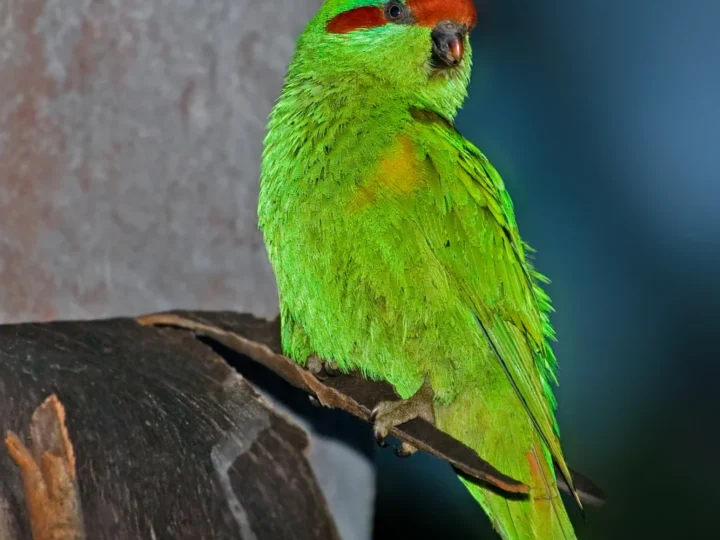
The Scaly-breasted Lorikeet is a common source of confusion in eastern Australia. It is mostly green, with yellow scalloped markings across the breast and body, and lacks the Rainbow Lorikeet’s bold blue head and orange chest. Musk Lorikeets are smaller and greener again, with red around the face rather than a blue head.
Quick identification tip
If the bird is a noisy medium-sized parrot with a blue head, green wings, orange-yellow chest and red-orange bill, a Rainbow Lorikeet is the leading candidate. Location and behaviour can help confirm the identification.
Sources
Species information checked against BirdLife Australia and the Australian Museum.